

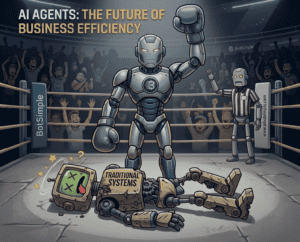
There is a tendency to reduce an AI Agent to a simple function, usually associated with replying faster or being available outside of working hours, when in reality its role becomes much more relevant once it is embedded into the way a business handles incoming leads from start to finish.
Lead management is not a single interaction but a sequence of dependent steps, where timing, context, and follow-through determine whether a conversation progresses or quietly disappears. When those steps rely entirely on manual execution, inconsistencies inevitably appear, especially as volume increases.
An AI agent, when properly implemented, introduces structure into that sequence, allowing each interaction to follow a defined path instead of depending on availability or memory.
How an AI Agent Structures Lead Handling From the First Interaction
The initial moment when a lead reaches out is often treated as a simple response task, yet it plays a disproportionate role in determining how the rest of the conversation unfolds. A delayed or generic reply does not just slow things down, it changes the perception of the interaction and reduces the likelihood of continued engagement.
By introducing an AI agent at this stage, the process becomes consistent rather than reactive. Every inquiry is acknowledged immediately, but more importantly, it is handled within a predefined framework that maintains tone, direction, and intent regardless of timing or volume.
This consistency is difficult to achieve manually, particularly in environments where multiple channels such as social media, website forms, and inbound inquiries operate simultaneously.
For a deeper look into how response time impacts conversion, this breakdown from Harvard Business Review provides useful context on why timing plays such a critical role in early-stage engagement.
How an AI Agent Improves Qualification Without Increasing Workload
Qualification tends to be one of the least consistent parts of the lead handling process, not because it is unimportant, but because it is time-consuming and often dependent on individual follow-through. As a result, some leads are explored in depth while others receive only partial attention.
An AI agent introduces a layer of standardization by guiding each conversation through a defined set of questions and checkpoints, ensuring that relevant information is collected in a structured way. This does not eliminate human involvement, but it changes when and how it is required.
Instead of starting every conversation from zero, teams engage with leads that already carry context, which naturally improves efficiency and reduces the cognitive load associated with repetitive qualification tasks.
If you want to see how this applies specifically in real estate environments, you can explore our previous breakdown on internal workflows here:
👉 https://aibotsimple.com/the-smartest-2026-shift-real-estate-ai-agents/
How an AI Agent Connects Systems Using Integrations and Automation
Even in relatively simple setups, lead handling rarely happens in one place. A CRM stores information, messaging platforms host conversations, and scheduling tools manage availability, creating a fragmented experience that depends on manual coordination.
An AI agent becomes significantly more valuable when it operates across these systems rather than within a single interface. Through integrations, API connections, and tools such as Zapier, it is able to move information between platforms, trigger actions, and maintain continuity without requiring constant intervention.
This is where the shift from tools to systems becomes visible. Instead of navigating between platforms to complete individual tasks, the process runs as a connected sequence where each step informs the next.
For a broader understanding of how automation workflows function across platforms, the official documentation from Zapier offers a useful reference point for how these connections are typically structured.

How an AI Agent Moves Conversations Toward Conversion
A large portion of conversations do not fail due to lack of interest, but rather because there is no defined transition from interaction to action. Questions are answered, information is exchanged, yet the conversation remains open-ended without progressing toward a clear outcome.
An AI agent addresses this by introducing direction. Once intent is identified and basic qualification is completed, the interaction can be guided toward a next step, whether that involves scheduling, further information, or escalation to a human team member.
This structured progression reduces the number of conversations that stall midway and increases the likelihood that each interaction contributes to pipeline development rather than remaining isolated activity.
What an AI Agent Looks Like When It Is Not Properly Implemented
The difference between effective and ineffective use of AI is rarely tied to the technology itself and more often to how it is integrated into the overall process.
When an AI agent is configured only to respond, it tends to generate surface-level engagement without contributing to outcomes. Conversations continue, but they lack direction, qualification is inconsistent, and the system fails to create momentum.
This explains why similar tools can produce very different results depending on how they are structured and connected to the rest of the workflow.
Where an AI Agent Fits Alongside Human Teams
There is a practical distinction between tasks that require consistency and volume, and those that depend on judgment and relationship-building.
An AI agent is particularly effective in handling the former, managing initial interactions, maintaining follow-ups, and ensuring that no lead is left unattended. Human teams, on the other hand, remain essential for closing, negotiating, and building long-term relationships.
When both are aligned within the same system, the overall process becomes more efficient without removing the elements that require human input.
How BotSimple Applies This in Practice
BotSimple is designed to operate at the system level rather than as a standalone tool, connecting conversations, qualification, and scheduling into a unified flow through integrations and automation.
Instead of relying on manual coordination between platforms, the process is structured so that each interaction follows a defined path, allowing businesses to manage increasing lead volume without adding proportional operational complexity.
If your current process still depends on manual follow-ups or disconnected tools, the limitation is not the volume of leads but the structure behind how they are handled.
Start your free trial and explore what an AI agent can actually do when it operates as part of a connected system rather than as a simple response tool.